


T1D Guide
T1D Strong News
Personal Stories
Resources
T1D Misdiagnosis
T1D Early Detection
Research/Clinical Trials
5 Best Continuous Glucose Monitors for 2026: Most Accurate and Latest Devices Reviewed
Continuous glucose monitors (CGMs) are wearable devices that provide real-time blood sugar data to help people with type 1 and type 2 diabetes prevent dangerous glucose fluctuations and make smarter choices about food, exercise, and insulin dosing. In this updated 2026 guide, we cover the latest extended-wear systems, such as the Dexcom G7 15-day sensor, and expand on over-the-counter options, such as Dexcom Stelo and Abbott Lingo.

.webp)
Editor’s Note: T1DStrong regularly updates articles to reflect the latest developments and resources for people with type 1 diabetes. In 2025, the FDA issued recalls for certain Abbott FreeStyle Libre 3 and Libre 3 Plus sensors, as well as Dexcom G7 receivers. Both companies addressed the issues, recalled the affected devices, and confirmed that manufacturing problems have been resolved. As always, it’s important to discuss medical decisions with your healthcare provider.
If you’re newly diagnosed with type 1 diabetes (T1D), chances are that you’ve learned a great deal of diabetes-related technology terminology in a short window. A diagnosis brings a steep learning curve, followed by important decisions about which blood glucose meter (BGM), insulin pen, insulin pump, or continuous glucose monitor to use.
Hopefully, you have an excellent physician and healthcare team to weigh all the options with you.
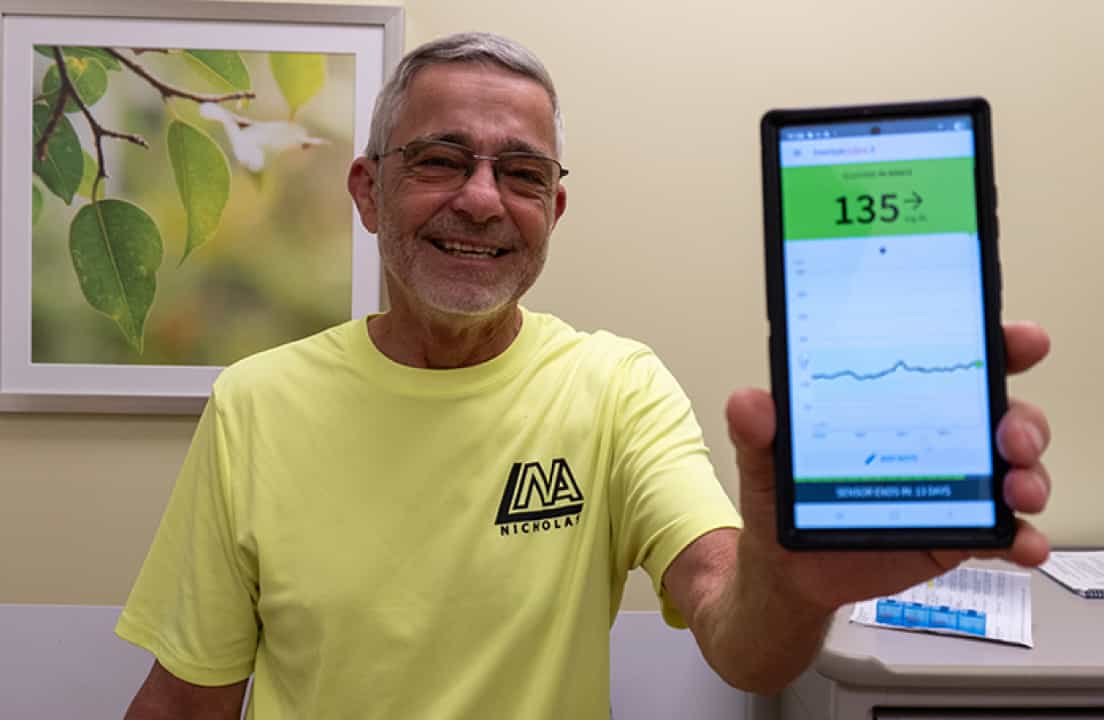
If you have the luxury of choosing a continuous glucose monitoring system, it provides a safety net against extremely low and high blood glucose levels. According to the American Diabetes Association (ADA), individuals wearing CGMs significantly benefit from higher Time in Range (TIR)—typically 70–180 mg/dL—by reducing long-term diabetes complication risks, improving daily energy and sleep, and reducing hypoglycemic events. An increase of 10% in TIR corresponds to a 0.5%–0.8% decrease in A1c, providing better, tighter glycemic control.
What is a Continuous Glucose Monitor (CGM)?
CGMs are wearable diabetes tech used to help manage blood glucose levels. The small device has a sensor worn under the skin that sends a signal to a transmitter/smartphone that shows the results.
Individuals can attach the sensor to their arms or stomach, where it automatically estimates their blood sugar level. The tiny needle stays under the skin, and the lengths vary according to your monitor type.
This real-time facet of CGMs is impressive, with calculations improving since its inception. Most health insurance plans cover CGMs, but you need a prescription. The exception to this is Dexcom's new Stelo Glucose Biosensor System, which can be purchased over-the-counter (OCT). Additionally, Abbott's Lingo (for metabolic health) and Libre Rio (for type 2 diabetes, non-insulin) are also OTC options launched in 2024.
Interesting Fact: Abbott is developing a new biowearable sensor that monitors both blood glucose and ketone levels in real time.
Here's T1D Strong's Quick List: Best CGMs for 2026
- Dexcom G7 – Best overall for accuracy and ease of use
- Abbott FreeStyle Libre 3 Plus - Affordable real-time CGM
- Medtronic Guardian 4 – Best for insulin pump users
- Eversense 365 – First long-term implantable CGM (365 days)
- Dexcom Stelo – First over-the-counter CGM for type 2 diabetes

1. Dexcom G7 (Bestover all for most users)
- Wear time: 15.5 days
- Accuracy: MARD 8.2% (adults), 8.1% (children), 7.7 for ages 2 to 6.
- Best for: People who want a fast warm-up, long wear-time, small size, and smartwatch compatibility
The Dexcom G7, released in early 2023, has many updated features compared to the Dexcom G6. Most notable is the size; the G7 is60% smaller than the G6, with a more circular shape, similar to the Freestyle Libre. Being smaller, it’s more comfortable and less intrusive.
The waterproof device is widely regarded as the best overall because of its high accuracy, small size, fast warm-up time (30 minutes compared to the G6’s two hours), and excellent app/smartwatch integration.
Most notably, the Dexcom G7 now offers 15.5 days of wear (including a12-hour grace period), up from the standard 10.5-day wear time of the original G7.
Another benefit of the G7, in addition to its shorter warm-up time, is its one-step application process. In contrast, the G6 has a two-step process and requires a separate transmitter.
Currently, the G6 offers broader insulin pump integration than the 67,though this is changing with wider compatible connectivity rolling out gradually.
- Dexcom G6: Widely compatible with Tandem t:slim X2, Omnipod 5, Omnipod DASH, and other systems.
- Dexcom G7: Integrates with Tandem Mobi and t:slim X2, with broader compatibility (including Omnipod 5) in progress.
Imortant Tip: Recent FDA notifications addressed issues with certain app versions and receiver devices that could affect alerts. Users are advised to keep their apps updated and check their receivers, but the G7 system remains FDA-cleared and widely available.

2. Abbott FreeStyle Libre 3 Plus (Affordable real-time CGM)
- Wear time: 15 days (with no warmup)
- Accuracy: MARD ~8.2% (Studies show Libre 3 and Dexcom G7 are very close in comparison)
- Best for: Affordability, people who want continuous real-time data and very small sensors.
- Suitable for children 2 years and older.
The Abbott FreeStyle Libre 3 Plus is a real-time CGM system, meaning it continuously sends glucose readings (every minute) to your smartphone viaBluetooth. It’s the world’s smallest and thinnest sensor (the size of twostacked pennies), and features enhanced connectivity, with a long-range Bluetooth connection (up to 33 feet).
The Libre 3 Plus works with several AID systems: Tandem: t:slimX2, Omnipod 5, iLet Bionic Pancreas, and Twiist. It’s water-resistant, withstanding immersion in up to three feet of water for up to 30 minutes.Device use is approved only on the back of the arm, not the stomach. The FreeStyle Libre is compatible with both iOS and Android Phones, and the application is easy to use on both.
Abbott touts that the FreeStyle Libre systems are “more affordable than other CGM systems,” even for those without insurance, noting that commercially insured patients usually pay $0–$75/month for sensors.
3. Medtronic Guardian™ 4 (Continuous real-time CGM)
- Wear time: seven days with two hour warm up
- Accuracy: MARD ~9–10% (varies by study)
- Best for: People using Medtronic insulin pumps who want seamless integration
The Medtronic Guardian checks glucose levels every five minutes, providing a constant stream of data to help users stay informed with trends throughout the day and night.
When paired with Medtronic’s MiniMed 780G insulin pump and SmartGuard™ technology, it stands out for its calibration-free operation, seamless integration, and a consistently reliable seven-day wear time on the abdomen, upper arm and buttocks.
While its sensor size is larger than some competitors', it offers reliable glucose monitoring for users seeking seamless integration with Medtronic’s insulin delivery systems.
While it is compatible with iOS and Android users via the Guardian Connect app, it does not work with other glucose-monitoring apps and has three piece insertion, including the sensor, inserter and transmitter, compared to Dexcom’s all-in-one sensor.
Pro Tip: MARD (Mean Absolute Relative Difference) is the standard way to measure CGM accuracy. For example, the Dexcom G7 claims an 8.2% for adults and 8.1% for children, and the G6 has a MARD of 9% for adults inserted into the stomach. The smaller the MARD score, the closer the CGM readings are to the real glucose value, while a larger MARD score suggests more discrepancies. Most systems have an average MARD of 9-14%.

4. Eversense® 365
- Wear time: 365 days (1 year, implantable)
- Accuracy: MARD 8.8%
- Best for: Adults seeking long-term wear, on-body vibration alerts, and fewer sensor changes
Ascensia Diabetes Care recently launched Eversense 365, a one-year implantable CGM for adults with diabetes. As the only CGM with a removable transmitter that can be easily taken on and off without wasting a CGM or adding a warm-up period, Eversense® 365 requires only a single warm-up period each year.
Following the recent FDA approval, this new development is transforming diabetes management, as Eversense is now the World’s First One-Year CGM. One implanted sensor provides long-term, year-round use, compared with 10-14 days of short-term CGM service. Eversense 365 reduces the burden of data interruption and sensor failures. Other benefits include more freedom, comfort, improved discretion, and on-body vibration alerts that notify patients even when their mobile phone is out of sight.

The Eversense 365 Continuous Glucose Monitoring system boasts an impressive (MARD) of 8.8%, indicating high accuracy in glucose measurements.
However, currently, the Eversense 365 is FDA-approved only for adults aged 18 and older. While the company has initiated clinical trials involving pediatric participants, the device is not yet approved for use in children.
Interesting Fact: People without diabetes with a history of hypoglycemia or individuals who simply want to control their diets are wearing CGMs.
5. Dexcom Stelo (OTC, Type 2 focused)
- Wear time: 15 days
- Accuracy: Built on G7 platform, similar performance (around 8–9% MARD)
- Best for: Adults with type 2 diabetes who are not insulin-dependent and want an over-the-counter CGM
Dexcom’s new Stelo is the first FDA-approved glucose biosensor designed for people living with type 2 diabetes (T2D), and the first OTC CGM available without a prescription. Stelo is built on the same Dexcom G7 platform, but it’s intended for a T2D audience and is manufactured with different software and a user experience tailored to this audience. Stelo users are typically individuals who aren’t insulin dependent. The G7 has alerts for low blood glucose levels for insulin users, while the Stelo sends phone alerts for glucose spikes.
The Stelo app focuses on real-time insights and glucose trends, while theG7 is laser-focused on low blood sugar alerts. The sensor warm-up/calibration period is approximately the same as the G7, with a 30-minute warm-up time.
Should I Get a CGM?
The recommendations for acquiring a continuous glucose monitor are increasingly favorable. The American Diabetes Association, Breakthrough T1D (formerly JDRF), the National Institutes of Health (NIH), and the Endocrine Society all say CGMs help individuals with type 1 and type 2 achieve their glycemic targets.
Doctors especially advocate CGMs for people with problematic hypoglycemia and hypoglycemic unawareness, which occurs when an individual doesn't feel a low blood glucose episode. Hypoglycemic unawareness affects about 40% of people with type 1 diabetes.
CGMs are considered a closed-loop system or artificial pancreas connecting to an insulin pump acting as the body's pancreas.
When choosing a CGM, you must consider many factors besides its unique bells and whistles: price, ease of use, connectivity, accuracy, and data management.
Bottom Line: CGMs are a Life-Saving Technology
If you are fortunate enough to try a CGM system, these AI-tracking devices are the future of diabetes care. Glucose meters and syringes may one day be a thing of the past. Just as smartphone apps and smart devices are a part of everyday life, diabetes technology is growing exponentially to the point where commercial insurance companies will be forced to cover most individuals.
The CGM sensors keep getting smaller, they provide excellent target range, and the devices make it easier for patients to participate in clinical trials. CGM systems allow T1D individuals increased wearability and reliability by adding the freedom to pursue intense physical activity and lengthy outdoor adventures.
CGMs allow T1Ds control over their condition with continuous feedback. If you want to participate in your diabetes care proactively and can afford one, CGMs stand out. They help you make informative decisions based on actual statistics and can be a game changer for improving your hemoglobin A1c level and overall health.


.webp)



.jpg)


.jpeg)
.jpg)
.jpg)

.jpg)
.jpg)
.jpg)

.jpg)

.jpg)
.jpg)
.jpg)



.jpg)


.jpg)




.jpg)
.jpg)


.jpg)
.jpg)



.jpg)
.jpg)
.jpg)
.jpg)
.jpg)
.jpg)
.jpg)

.jpg)
.jpg)
.jpg)


.jpg)
.jpg)
.jpg)

.jpg)

.jpg)




.jpg)


.jpg)


.webp)


.webp)


.webp)
.svg)