


T1D Guide
T1D Strong News
Personal Stories
Resources
T1D Misdiagnosis
T1D Early Detection
Research/Clinical Trials
When the Signs Don’t Add Up: Misdiagnosed at 60
Misdiagnosis doesn’t only happen to children or young adults. Many older adults develop type 1 diabetes (T1D), yet their symptoms are often waved away or misread. This is the story of Åsa Carlsson of Dalsland, Sweden, who lived for years with symptoms no one could explain. Her path to the right diagnosis shows what happens when something feels wrong, but the healthcare system insists everything is fine.
.jpg)

When a Healthy Life Still Can’t Keep Illness Away
Before her diagnosis, Åsa lived a lifestyle most doctors would describe as ideal. She had spent more than a decade eating gluten-free, cooking every meal from scratch, avoiding refined carbs, baking her own seed breads and crackers, choosing organic foods, strength-training, walking daily, and practicing yoga several times a week. Active leisure filled the rest of her time.
“I checked all the boxes for a healthy lifestyle for at least 10–15 years,” she said. Which made the slow decline in her energy between 2019 and 2023 feel even more confusing. She sought medical care more than once for “unbearable fatigue,” yet no answers came.
In February 2023, everything intensified. “Extreme dry mouth. Urinating a lot. Thirst that never ended. Muscle pain in my arms and thighs. Joint pain. Short-term memory loss. Heart fluttering. Pressure on my chest. I couldn’t train up my fitness. My sleep was disturbed.”
The symptoms piled up until daily life became frightening. “The fear of all the symptoms made me depressed,” Åsa said. “I felt really bad.”
Lab work looked normal. She was sent home. But she knew something deeper was unfolding.
Her body had already been through a lot. She’d rationed estrogen therapy during a pharmacy shortage and had her first round of COVID that same month. Both complicated the picture, but still didn’t explain the thirst, the urination, or the exhaustion.

The Moment the Truth Revealed Itself
Åsa’s turning point came on a spring trip to Berlin to celebrate her 60th birthday with her daughter. After intentionally choosing a carbohydrate-heavy dinner, she checked her blood sugar the next morning using her daughter’s glucose meter.
“Then I knew,” she said. “And considering my lifestyle, I did not believe in type 2 at all.”
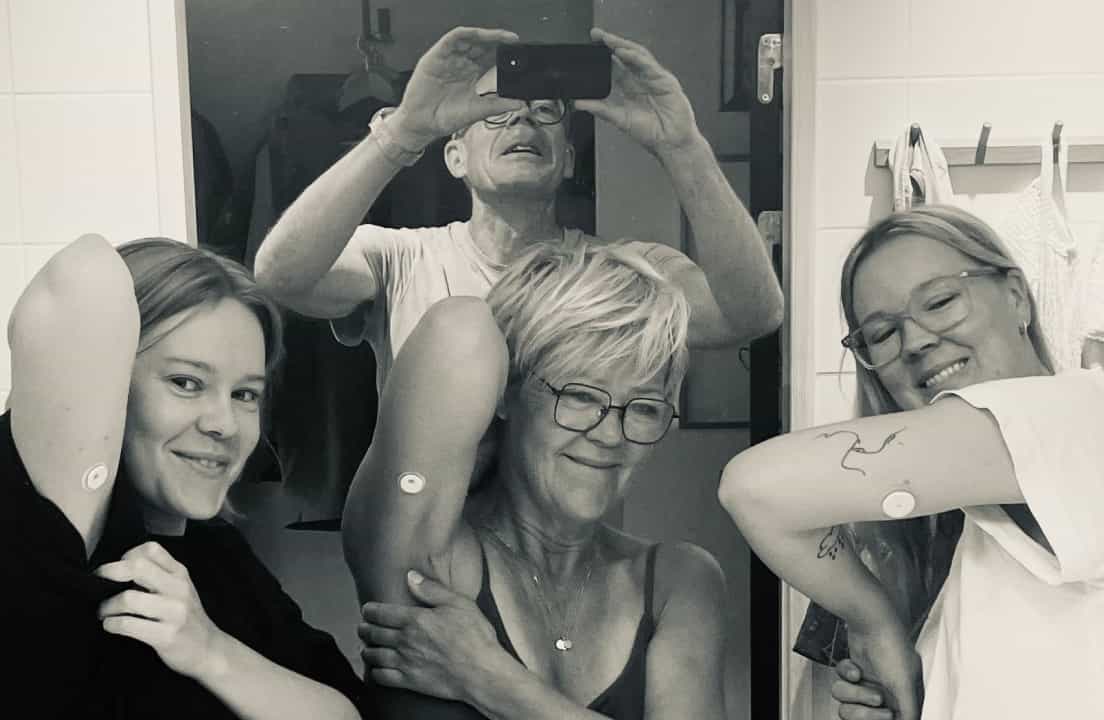
Both of her daughters live with T1D, so she recognized the signs instantly. And her daughters recognized them in her.
“Absolutely, that both my daughters and I understood,” she said.
But understanding and being believed were two different battles.
When Doctors Don’t Hear You
Åsa raised her concerns with her medical team. Their response didn’t align with her analysis. “At first, they thought it was type 2, not ‘childhood diabetes.’ They didn’t listen but saw my fine numbers.”
Type 1 diabetes used to be referred to as juvenile diabetes until data showed that half of all new cases occur in adults. This healthcare bias still contributes to misdiagnoses today, and Åsa didn’t accept that answer—she knew her intuition was right.
She had watched her daughters navigate type 1. She knew her symptoms. Åsa reached out to a well-known endocrinologist in desperation. His reply brought the clarity she had been missing.
“Your symptoms and the low C-peptide value speak for T1D or LADA,” he wrote. He told her to request antibody testing. He also reminded her that type 1 can unfold slowly in adults. “Type 1 diabetes can develop slowly over one to two years as you get older.”
With that guidance, Åsa sought a second opinion privately. She pushed for the right tests: C-peptide, GAD antibodies, and insulin antibodies. When the results came in, her suspicion was confirmed.
By June 2023, she was diagnosed with T1D.
She also received a diagnosis of Graves’ thyroid disease, a double blow that complicated everything.

The Shock of a Diagnosis You Thought You’d Escaped
Åsa’s daughters were 13 and 19 when they were diagnosed. Watching them grow up with type 1 shaped much of her family’s life. But she never expected to receive the same diagnosis decades later.
“I never imagined that I would be affected at 60,” she said. “I thought my family had been affected enough before.”
The emotional weight was heavy. “Grief. Anger. Disappointment at the injustice of life. Does anyone want to punish me?”
For Åsa, type 1 wasn’t even the hardest part. “Graves’ thyroid disease caused ophthalmopathy that has devastated much of my life,” she said. Her eye complications reached a point where she wondered, “How will I be able to take my insulin if I go blind?”
Three eye surgeries in two years followed. Double vision. Light sensitivity. A daily fight to protect what vision she still had.
Seeing Her Daughters’ Lives Through New Eyes
Living with type 1 changed how Åsa understood her daughters’ experience.
“I have seen my children take on so much responsibility in life just when you want to test boundaries and live life,” she said. “I have seen their wings clipped.”
Looking back, she felt a new grief for what teenage Åsa might have lost had she been diagnosed young. “It can make me incredibly sad to think about today when I actually know what it is like to live with type 1 on the inside.”
Misconceptions That Shadow Adult-Onset Type 1
“Everyone thinks I have type 2,” Åsa said. She often has to quickly explain, “I’m type 1.”
These assumptions stall care and misalign appointments. Even her first medical team assumed type 2 because of her age. But T1D has no age limit. It is not exclusive.
Åsa’s story is proof.
Discipline, Survival, and the Push for a Full Life
Åsa’s daily management is shaped not only by diabetes but by her eye disease. Blood sugar control directly affects vision.
“I’m incredibly disciplined with my diet and exercise,” she said. “My blood sugar is almost always between 3.8 and 9 mmol. Everything gets worse with higher blood sugar.”
Some people with diabetes occasionally choose to ignore their numbers to feel “normal,” but Åsa cannot risk the consequences. “It’s not worth feeling so bad to be able to eat something that easily causes high blood sugar.”
Despite everything, she refuses to shrink her life. “I learned to ride a bike again this summer,” she said. “I’m going to try cross-country skiing this winter, maybe slalom.”
Her joy in movement is still intact.
A Family That Understands, Even When It’s Too Much
Sharing type 1 with her daughters brought both closeness and pressure.
“In a way, we know what we are going through,” Åsa said. “But at the same time, it has become too much.”
Her daughters, now adults themselves, suddenly had to teach their mother. “Educating mom has been a task that has not been great,” she admitted. Still, “When it comes down to it, we are there for each other.”
Advice for Adults Pushing for the Right Diagnosis
Åsa carries a quiet steadiness shaped by everything she has endured. Her message for older adults fighting for answers is clear.
“Don’t give up,” she said. “Yes, it’s awful, but the odds are better with knowledge of your diagnosis.”

She believes in letting the hard days happen but not letting them stay forever. “Many days the glass is half full. On the days when it’s half empty, let them come and let them pass.”
Her advice is practical:
“Find your tools to get out of your head and into your body. Learn how diet affects you. Choose a lifestyle you can feel good about. Learn to cook from scratch. Find movement you enjoy. Measure and learn. Respect recovery. Know that you have insulin and you have movement to work with.”
Life After Misdiagnosis
Summarizing Åsa’s experience is difficult. She lived through years of fear, confusion, and the slow unraveling of her vision. She rebuilt her routines more than once. She adapted, then adapted again.
She once worked as a graphic designer and illustrator, but eye complications made screen work difficult. “I try to paint in my studio,” she said.
Her life looks different now, but it remains full of creativity and determination.
Åsa may have been misdiagnosed and overlooked, but she kept pushing until she reached the truth. Her story reminds us that answers are worth fighting for—and that late-onset T1D deserves to be seen.


.webp)
.webp)



.jpeg)










.jpg)




.jpg)



%20(1).jpg)




.jpg)
.jpg)
.jpg)
.jpg)
.jpg)

.jpg)
.jpg)
.jpg)
.jpg)
.jpg)
.jpg)

.jpg)
.jpg)
.jpg)
.jpg)

.jpg)

.jpg)
.jpg)



.jpg)

.jpg)
.jpg)


.jpg)
.jpg)

.jpg)
.jpg)
.jpg)
.jpg)
.jpg)

.jpg)
.jpg)
.jpg)
.jpg)
.jpg)
.jpg)
.jpg)
.jpg)
.jpg)
.jpg)

.jpg)
.jpg)
.jpg)


.webp)
.svg)