


T1D Guide
T1D Strong News
Personal Stories
Resources
T1D Misdiagnosis
T1D Early Detection
Research/Clinical Trials
How Stash Diabetes is Simplifying Type 1 Supply Tracking, with Founder Cory Zapatka
If you ask most people with diabetes and parents of children with type 1 diabetes (T1D) what some of the most frustrating facets of management are, many will point to keeping track of supplies, knowing when to reorder with insurance, and the constant fear of running out.

.webp)
More importantly, research now shows that added stress like this affects blood sugar regulation and overall health. A recent study from the academic journal, Frontiers in Clinical Diabetes and Healthcare, followed young adults (age 18-24) moving to self-diabetes care and found that more than one-third of patients with T1D reported feeling poorly prepared for the transition, which includes acquiring an adult endocrinologist, facing solo self-monitoring, and handling the burden of ordering supplies.
Reducing one source of stress in your life may lead to better clinical outcomes.
Fortunately, the diabetes community has innovators within its core group, one of them is Cory Zapatka, who’s lived with type 1 diabetes (T1D) since age 15. His brand-new Stash Diabetes app, founded in April 2026, has already been downloaded in 36 countries, and has over 600 users.

Zapatka plans for even more global outreach, in addition to adding the mylife YpsoPump, a popular insulin pump for T1Ds in Europe.
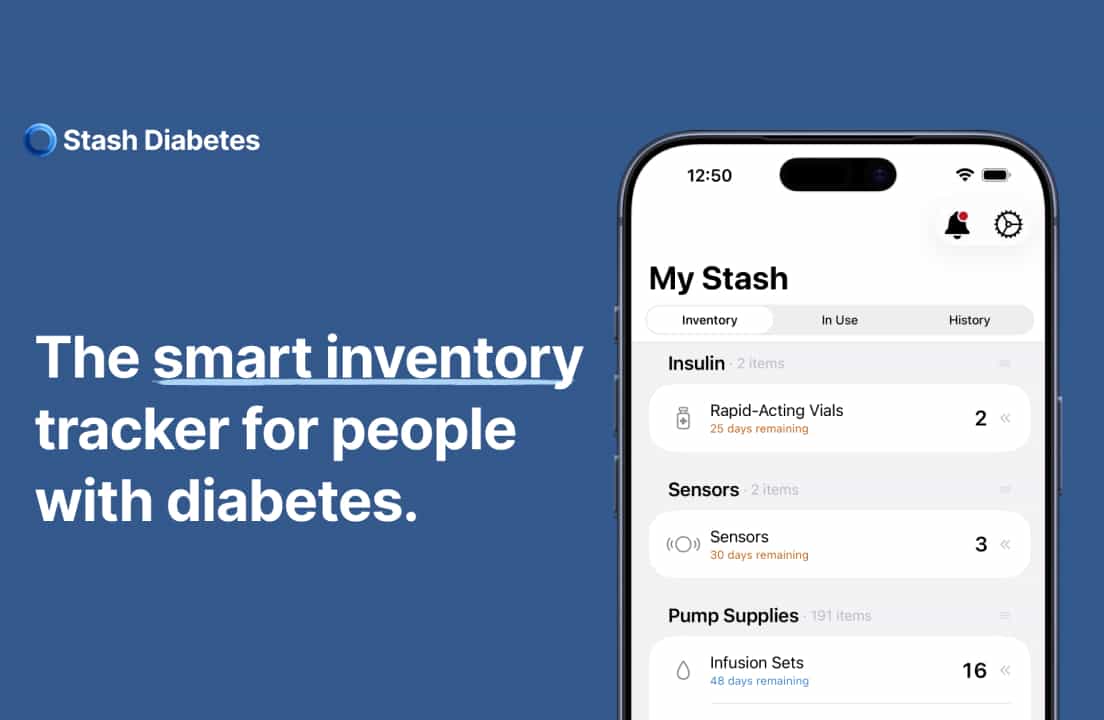
The free app, Stash Diabetes, helps individuals with type 1 and type 2 diabetes track insulin vials, pens, pods, continuous glucose monitors (CGMs), pump supplies and oral medications with important alerts and travel-planning features.
About Cory Zapatka
Diagnosed as a teen in 2005, Zapatka had a mother in healthcare who noticed the type 1 diabetes symptoms (leg cramps, weight loss and frequent urination). “She didn’t want to admit I was sick but knew right away what it was.” His blood sugar was in the 800s, and he was a few days away from diabetic ketoacidosis (DKA).
Zapatka had a family history of autoimmune illnesses, but not T1D. Five years later, he was diagnosed with celiac disease, a condition associated with type 1 diabetes. People with type 1 are at a significantly higher risk of developing celiac, with both diseases sharing a common genetic background.
When Zapatka was in the throes of new parenthood (he’s now the proud father of a seven-month-old daughter), he came up with the idea for Stash. “It was around the three-month mark, when you’re delirious, running on no sleep. I went to pull an infusion set and realized I only had one left. I had missed the notifications because I wasn’t checking my emails.”
His low-inventory scare occurred in January 2026, and by February, he had started building the project/app and launched Stash in March 2026.
An engineer friend told him the best way to develop something is to build a system that you would use. “I built this for myself, and I built it with heart, and I built it with 20-plus years of experience, and I think that’s what sets it apart from some other quickly built apps popping up everywhere.”
Catalyst for Stash
Zapatka soon realized there wasn’t a single app that focused solely on the logistical side of diabetes. “I really wanted to build something where you could have an overview of everything you have from different locations: school, work, home, or a friend’s house.
His day job is working on the brand team at the tech company Notion. Zapatka used his coding experience to build the Stash prototype in about three days with the help of Claude Code. After building the app for his own personal use (Humalog insulin, Tandem T:slim insulin pump infusion sets, and a Dexcom G7 CGM, he began entering other combinations for more users.
“A couple of weeks later, I started sharing it with my T1D friends, and they asked if I could enter different pumps, CGMs, and multiple daily injections,” he said. “It made me realize that no two diabetics have the same insulin therapy.”
Stash kept growing as it supported more ecosystems, and the app reached a point where Zapatka covered most insulin therapy combinations and felt ready to publish on the app store.
In a very short time, the app already has over 600 users. “It exceeded my expectations. Just seeing the growth has really been humbling,” said Zapatka.
Since the app is free, Zapatka thought he’d let it live there, and if it takes off, great. The first day, he posted about it on Reddit, and it got over 80 downloads. “It was incredible but also scary. The feedback was amazing. People from all over the world started messaging me. I had a guy from Norway helping me update features.”
Stash Diabetes App Key Features
Inventory Tracking
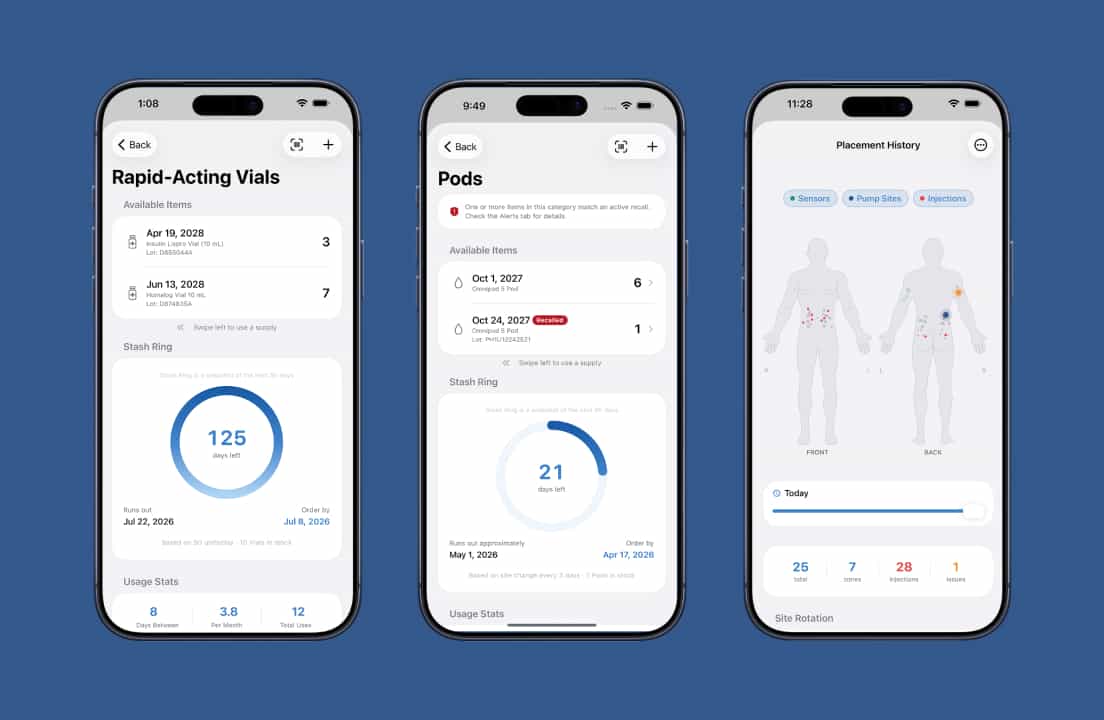
The Stash app tracks supply inventory and automatically calculates remaining estimates. The list includes insulin vials/pens, sensors (Dexcom, Libre, Eversense), and pump supplies (Omnipod, Tandem, Twiist, Beta Bionics, Medtronic, YpsoPump).
There’s a smart deduction setting that lets you group “Pump Changes” (cartridges, tubing, alcohol swabs, reservoirs, etc.) and deduct them automatically.
Barcode Scanner
The Stash app is simple. Users can use the barcode scanner to enter supply boxes. It auto-fills lot numbers, expiration dates, and serial numbers. “The barcodes have a ton of information most people don’t realize,” said Zapatka. “When you scan one, it has a GTIN number, lot number, and expiration date. The app sorts your inventory by expiration dates.”
Trip Planner
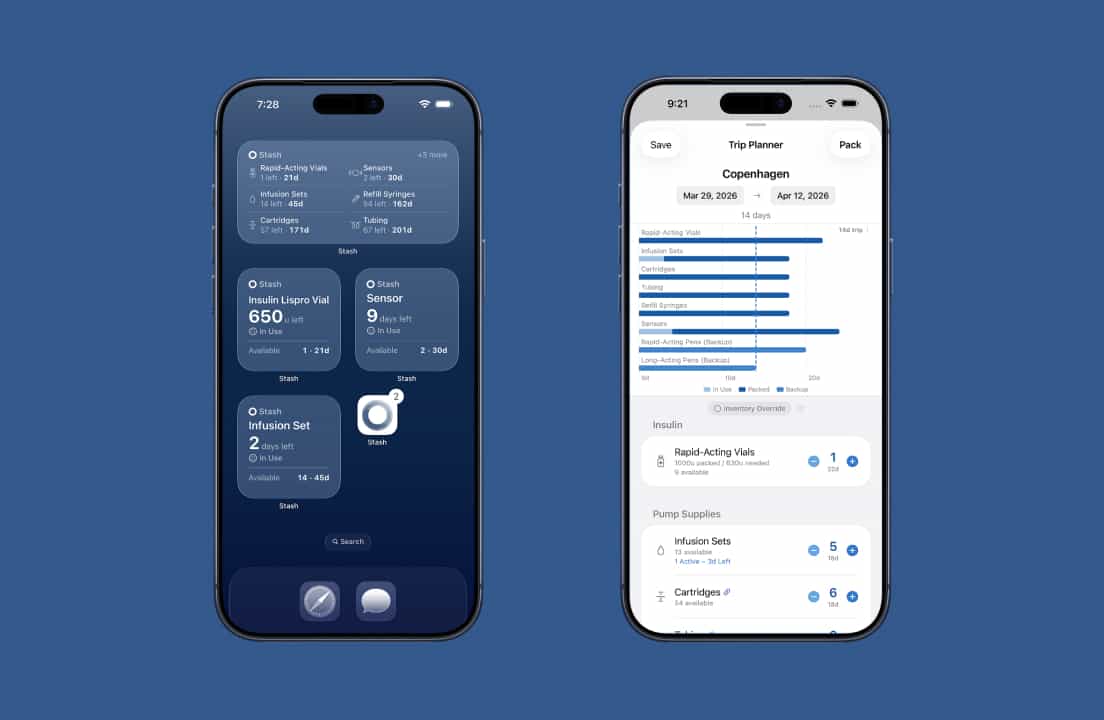
Stash helps users create packing checklists and builds a visual coverage chart to ensure you have enough supplies for trips.
Site Rotation & Tracking Reminders
Stash offers body-site tracking for sensor and infusion set changes via a visual map. Site tracking is crucial to prevent skin damage, as rotating sites allows tissues to heal and maintain accurate glucose readings, ensuring precise absorption and sensor accuracy.
Shared Stashes
This feature allows caregivers and parents the ability to monitor inventory remotely and receive notifications. Either the parent or the child can have a “Read Only” capability, and the other can follow.
Recall Alerts
The Stash app automatically flags any Lot number if your inventory is affected by manufacturer recalls.
Notifications
The app also sends push notifications for low stock, expiring items, and site changes.
Usage Reporting
This key feature provides reports to share with healthcare teams. There is also an alert that warns against overfilling. “Sometimes you don’t want insulin sitting in the cartridge for longer than three days,” said Zapatka.
One user posted on the Apple App comments, “I started using Stash a few days ago, and it’s already been able to pick up patterns I never realized (I’ve definitely been overfilling my cartridges). The time remaining calculations give me clarity on when I’ll need to reorder, and the trip planner has already been super helpful for a 4-day business trip. I showed my endocrinologist the app, and even he was super impressed. I wish I had this app sooner.”
Multi-Location Support with Side Stashes
The app works on iOS and supports iCloud sync for tracking across multiple devices. The Stash feature called ‘Side Stashes’ allows users to manage supplies at home, work, or school.
Though Stash is currently available only on iPhone, Zapatka would love to expand to Android, but there are security levels he needs to work out. “Apple is safe and encrypted within the Apple system, it will take a bit longer for me with Android.”
Stash Teaches Self-Sufficiency
One important milestone for T1D parents of teens is to teach self-sufficiency. Stash helps prepare adolescent T1Ds for a supply management mindset.
Zapatka has found that parents are reaching out to him as their kids attend college. In the app, you can share data and view information with multiple users. And if you’re traveling abroad, the app helps keep track of your supplies while on vacation.
“Stash is very settings-heavy, so you can fine-tune the app to meet your exact needs,” said Zapatka.
Stash reduces the T1D Burden
Keeping track of so many balls in the air can be all-consuming. Stash helps mitigate one area of worry. Zapatka’s goal is to keep the app free forever. He hopes to further protect the diabetes community through the app by adding a feature to report supply issues. This feature, which should be live in June, will allow users to submit anonymous device failures, and the lot numbers will be flagged for other users to monitor. The anonymous data will be used to flag failure clusters and to bring transparency to quality-control issues with devices used to treat diabetes.
With Stash’s barcode capability to report problems through automatic recall alerts, people can learn more quickly when an issue arises and notify others. “We could throw a warning up or take the data and give it to the company to hopefully find defects. This is a feature I’m really excited about.”
Zapatka is open to feedback from users and caregivers. You can reach him at cory@stashdiabetes.com.


.webp)
.jpeg)












.jpg)




.jpg)




.jpg)



%20(1).jpg)




.jpg)

.jpg)
.jpg)
.jpg)
.jpg)
.jpg)
.jpg)

.jpg)

.jpg)

.jpg)
.jpg)

.jpg)
.jpg)

.jpg)
.jpg)
.jpg)


.jpg)

.jpg)

.jpg)
.jpg)



.jpg)


.jpg)

.jpg)



.jpg)
.jpg)
.jpg)

.jpg)

.jpg)


.jpg)

.jpg)
.jpg)
.jpg)
.jpg)


.webp)
.svg)