


T1D Guide
T1D Strong News
Personal Stories
Resources
T1D Misdiagnosis
T1D Early Detection
Research/Clinical Trials
UK Children’s Author Tim Manning Creates Diabuddies to Help Children with T1D
After living with type 1 diabetes (T1D) for over 40 years, Tim Manning saw the need for resources to help T1D children understand the condition in a positive light. Growing up in Liverpool, England, in the eighties, he had far less education and support than is offered today, but it fostered his independence and a drive that empowered him to help others.

.webp)
Manning was eight years old at the time of his diagnosis. Over a period of a few days, he grew very ill with severe weight loss, frequent urination, increased thirst, hunger and fatigue.
“My parents took me to the doctors, and after a urine and blood test, I was diagnosed with type 1 diabetes. I had never heard of it,” said Manning. “In all honesty, I’m not even sure my parents knew what it was. I was admitted to the hospital straight away. I remember my blood sugar being in the 30’s mmol.”
In the US, blood sugar is measured in mg/dL, while many other countries use mmol/L. A reading in the 30s mmol/L range corresponds to 540-702 mg/dL.
Fortunately, Manning stayed conscious throughout his bout with diabetic ketoacidosis (DKA), but he remembered it being very close.
Family Support is Critical
Since adolescents with type 1 diabetes require around-the-clock care, family involvement is vital to the well-being of the child. Receiving medical treatment that includes intervention for emotional and psychological health has been proven to improve outcomes and stabilize glycemic levels.
Manning said his family’s encouragement played a huge role in helping him manage his diabetes. “I often think about how hard it must have been for them. The way I look at it is we all had type 1 diabetes, we were all living with the condition.”
Like most T1D cases, the Mannings had no family history. When Tim’s mother told the doctor this, he said, “Family history has to start with someone.”
Thankfully, today, Manning’s wife is a critical care nurse and often treats patients with diabetes in her work. Because of his own experience, Manning has always been very aware of the symptoms of type 1 and watches his children for signs.
“It’s always something that remains in the back of my mind as a parent living with the condition. My son has celiac disease, which is closely associated with type 1 diabetes through its autoimmune links.”
Yesterday’s Healthcare Vs. Today
The changing nature of healthcare is far better now than it was thirty years ago. Though healthcare costs continue to rise, medical advancements in technology, vaccinations and access to care have steadily increased.
“The healthcare support was very different when I was diagnosed,” Manning said. “Compared to today, there was far less education, technology, and ongoing support available, and many families were largely left to manage the condition themselves. While that presented challenges, it taught me independence and the importance of supporting others living with type 1 diabetes.”
“The most challenging part of type 1 diabetes is that it never takes a day off. There is no pause button. Every day involves making countless decisions about food, insulin, exercise, work, sleep, and overall health. Even when you do everything right, blood sugars can still be unpredictable.”
“Growing up, I often felt isolated and rarely met anyone else living with the condition.”
This separation motivated him to put pen to paper.
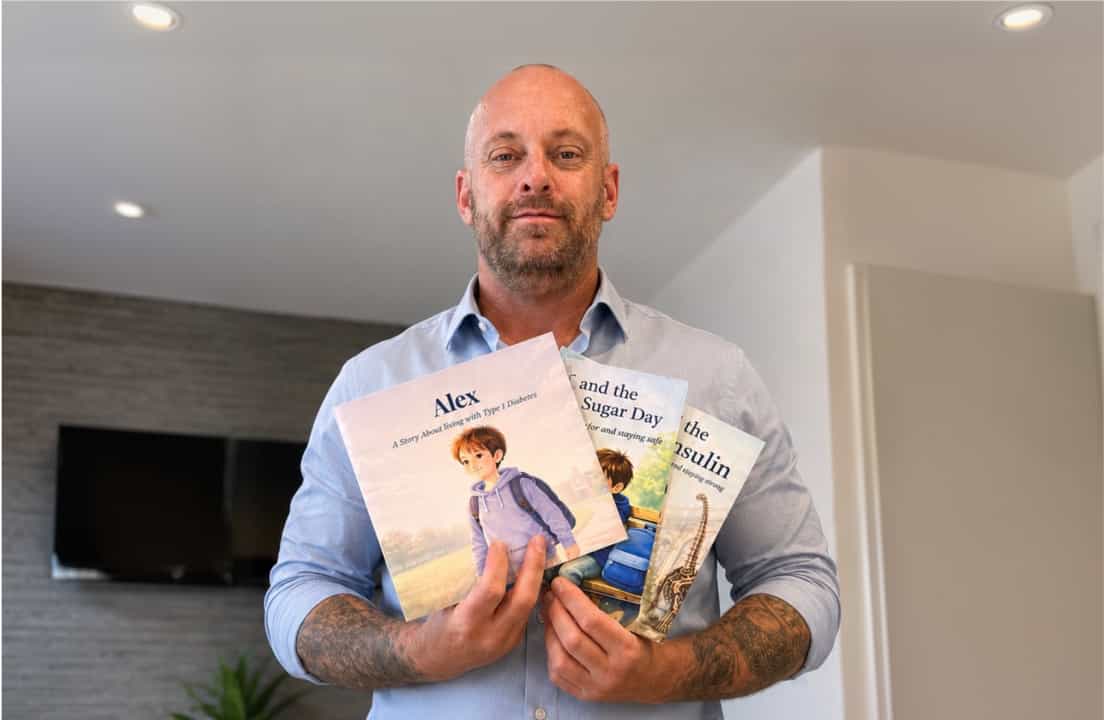
Children’s Book Author
After living with the condition for decades, Manny realized there was a need for resources that could help children understand the condition in a positive, age-appropriate way.
“I wanted to create something that would help children feel less alone and more confident.”
His first children’s book, Alex: A Story About Living with Type 1 Diabetes, follows a young boy as he learns to navigate school, friendships and daily blood sugar checks after being diagnosed with T1D. The story and its two consecutive ones are designed to teach children that type 1 diabetes doesn’t define who they are.
The supportive, relatable narrative helps newly diagnosed kids feel less alone while building the confidence to manage their health.
“The response was incredibly encouraging, so I continued the series with Alex and His Low Blood Sugar Day. I have just finished my third book, Alex and the Power of Insulin.”

Each book guides children and families through different aspects of living with the condition, using relatable scenarios and characters. All books are now available on Amazon.
Manning is also in the early stages of writing a diary-style book for teenagers and young adults. “It will take a lighter and more humorous look at living with type 1, drawing heavily on my own experiences,” he said. “My hope is that the readers will recognize themselves in many of the stories, laugh at some of the situations, and realize they are not alone in what they experience.”
Manning said the goal with all of his books is simple: to educate, raise awareness and help people feel understood.
Team Diabuddies
Navigating the challenges of a complex autoimmune condition like type 1 diabetes requires constant vigilance, precise balancing of carbs and insulin, and a good mix of emotional support. Since most of us are on our phones throughout the day, online encouragement can help T1Ds through many challenges.
Manning started sharing his platform, Team Diabuddies, to connect with others affected by the condition.
“I started posting because I wanted to be honest about the realities of type 1 - the challenges, the frustrations, the victories and everything in between,” he said. “One of my favorite sayings is that I won’t sugar-coat diabetes. Over time, I found that people related to that honesty. Knowing that a post might help someone feel understood or less alone is what continues to motivate me today.”
Diabuddies is intended to be much more than a social media account or book series.
“My long-term vision is to create resources and support for children living with type 1 so they feel less isolated and more confident.”
Today, around 95% of his content is created for TikTok (@team_diabuddies), but you can also find him on Instagram and Facebook.
Building Community From Experience
Today, Manning lives with his wife and three children, who have been incredibly supportive of his journey. He’s also fortunate to be part of a wider type 1 diabetes community.
“Through social media, advocacy and the connections I have made over the years, I have built relationships with many people living with type 1 diabetes, as well as parents and caregivers. That sense of community is invaluable, and one of the reasons I am passionate about helping others feel less isolated than I did growing up.”
“Finally, if my journey has taught me anything, it is that challenges can be turned into opportunities. What began as a diagnosis 40 years ago has led me to write books, advocate for the diabetes community, connect with thousands of people through social media, and, hopefully, make a positive difference in others’ lives. If sharing my experiences helps even one person to feel understood or supported, then it has been worthwhile.”
Alongside the books and social media content, Manning is passionate about advocacy through Type 1 Matters, a campaign focused on raising awareness, support, and equality for those living with T1D.
No One Should Face T1D Alone
One of his longer-term goals is to develop resources not only for children, but also for parents, schools, teenagers and young adults affected by the condition.
“Advocacy around awareness, access to technology and support for people living with type 1 diabetes is a major part of what motivates me,” said Manning. “Type 1 diabetes is far more than a condition that affects blood sugar levels. It impacts every aspect of a person’s life, often in ways that are invisible to others. I encourage anyone affected by type 1 diabetes to remember that they are not alone. The diabetes community is full of people who understand, support and inspire one another.”


.webp)

.jpeg)


















.jpg)






.jpg)






.jpg)







%20(1).jpg)







.jpg)

.jpg)
.jpg)
.jpg)
.jpg)
.jpg)
.jpg)
.jpg)


.jpg)
.jpg)

.jpg)

.jpg)
.jpg)

.jpg)
.jpg)

.jpg)
.jpg)
.jpg)
.jpg)

.jpg)

.jpg)
.jpg)

.jpg)
.jpg)


.webp)
.svg)